
History of Bellevue's Japanese American WWII Incarceration, Told by Densho
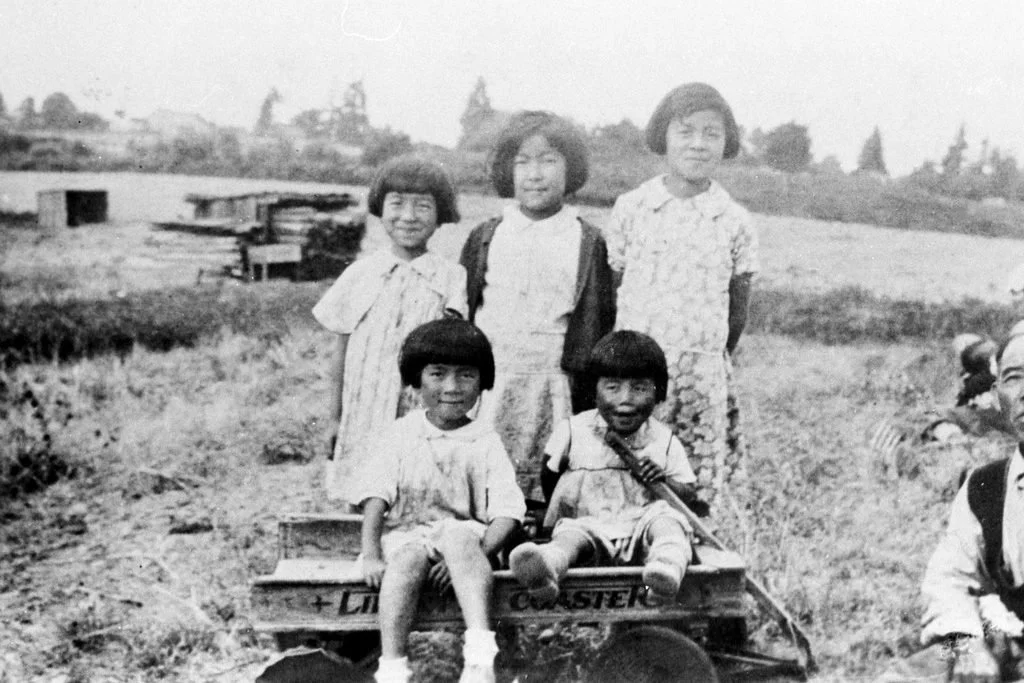
This photo was taken in 1933. The Suguro farm was located in the Midlakes area of Bellevue, Washington. Image courtesy of the Akizuki Collection.
Densho
Densho (伝承), meaning “to pass on to the next generation,” is a digital archive and public history organization founded in 1996. Our name reflects our mission: to preserve and share the history of the WWII incarceration of Japanese Americans in order to promote equity and justice today.
During World War II, the U.S. government incarcerated innocent people solely because of their ancestry. Densho preserves and shares the firsthand experiences of Japanese Americans who were unjustly incarcerated, making their testimonies, photographs, letters, and other archival materials accessible for education and reflection on democracy, civil rights, and the responsibilities of citizenship.
Our online platforms provide access to more than 1,200 oral histories and over 140,000 archival items, along with free educational resources. Densho’s work is used by educators, researchers, and journalists as a trusted source on this subject. Through initiatives such as our artist-in-residence program, we also support work that brings these stories into conversation with the present. As we mark our 30th anniversary, we continue to expand access to these materials, ensuring that this history remains visible, meaningful, and resonant for future generations.
To learn more about our organization, visit densho.org.
Brief History of Japanese Americans in Bellevue
Immigration and Prewar
The areas now known as Bellevue and Factoria were home to satellite villages of the Duwamish Tribe, whose homelands have existed there since time immemorial, long before European settlement. Following the Treaty of Point Elliott in 1855, Seattle and the surrounding region became central to the Washington Territory as white settlers claimed land, logging operations clearcut much of the landscape, and railroads connected the area to the rest of the country.
Beginning in the mid-1800s, Japanese immigration to the Pacific Northwest and West Coast increased, particularly after the Chinese Exclusion Act restricted Chinese labor. Most early arrivals were young men who found work in logging, mining, railroad construction, and agriculture.
As Japanese immigrants began to establish their lives in the United States, their opportunities were shaped by earlier laws targeting Chinese immigrants. Under alien land laws, Asians were classified as “aliens ineligible for citizenship,” preventing them from owning land or naturalizing through pathways available to European immigrants. While the Page Act of 1875 severely restricted the immigration of Chinese women, Japanese immigrants were, for a time, able to establish families. Some marriages were arranged through photographs exchanged across the Pacific, leading to the arrival of so-called “picture brides” and the establishment of family and community life.
As Japanese immigration grew, anti-Asian sentiment intensified. Stereotypes and exclusionary attitudes previously directed at Chinese Americans were extended to Japanese Americans. Fears of the so-called “yellow peril” fueled concerns among white Americans about economic competition and social change. In 1907-1908, the Gentlemen’s Agreement between Japan and the United States curtailed the immigration of Japanese laborers, further shaping the development of these communities.
Despite these barriers, Japanese Americans established communities across the West Coast. In the Seattle area, many built farms on the Eastside and surrounding region, while urban neighborhoods and community networks provided support for new arrivals.
In Bellevue, farms were carved out of former old-growth timber forests. Transforming the land into farmland was difficult and dangerous work, as massive tree stumps remained from previous logging. These were removed through a combination of using dynamite and manual labor, much of it carried by Japanese immigrants.
As families took root, second generation Japanese Americans, or Nisei, grew up in the region. U.S. citizens by birth, Nisei children attended Bellevue public schools, participated in sports, and formed friendships with their peers.
Although Issei, first generation immigrants, were barred from owning land, many families secured property through their U.S.-born children. This allowed them to establish more permanent roots and build a stable community. Gathering at community halls, attending language schools, and participating in sports and cultural activities, Japanese Americans in Bellevue developed a vibrant and interconnected community.
By the eve of World War II, more than 70 Japanese American families lived in Bellevue, comprising approximately 15% of the population and 90% of the agricultural workforce. Their farms supplied fruits, vegetables, and dairy products to Bellevue and Seattle, contributing to markets such as Pike Place Market. Farmers also organized the Bellevue Vegetable Growers Association, shipping produce across the country by rail from a warehouse near the present-day Wilburton Light Rail Station.
Many Japanese Americans in Bellevue recall warm friendships with Scandinavian and other European American neighbors. Unfortunately, racial prejudice and organized discrimination persisted. Anti-Japanese sentiment was promoted by prominent Bellevue local figures such as Miller Freeman, a newspaper publisher and founder of the Anti-Japanese League in Bellevue. In 1919, Freeman wrote in the Seattle Star newspaper, “I am for a white man’s Pacific coast. I am for the Japanese on their own side of the fence. I not only favor stopping all further immigration, but believe this government should approach Japan with the view to working out a gradual system of deportation of old Japanese now here.”
Despite these tensions, Japanese Americans continued to build and sustain a close-knit community. The Bellevue Japanese Community Clubhouse became a central gathering place and a hub for language education, religious life, and activities such as basketball and judo. As the Nisei generation navigated their identities as both Japanese and American, these shared spaces fostered relationships, cultural continuity, and a sense of belonging.
World War II
Following the attack on Pearl Harbor by the Japanese military on December 7, 1941, many Japanese Americans in Bellevue later recalled exactly where they were when they heard the news. This moment marked a profound shift, altering how Japanese Americans were seen by others, and reshaping their sense of belonging in the communities they had built.
Amid long-standing anti-Japanese sentiment and fears of “enemies within,” Japanese Americans were unjustly targeted, mistreated, and denied their constitutional rights. With little or no evidence, community leaders were arrested by the FBI, separated from their families, and denied their constitutional rights. Tom Matsuoka, U.S. citizen and President of the Bellevue Vegetable Growers Association, was detained indefinitely, leaving his family to face uncertainty and fear.
On February 19, 1942, President Franklin D. Roosevelt signed Executive Order 9066, designating much of the West Coast as a military zone and authorizing the forced removal of all people of Japanese ancestry, including U.S. citizens. In the weeks that followed, “Evacuation Notices” were posted throughout the region. Families were given as little as one to two weeks to sell their farms and businesses, dispose of belongings, and prepare for removal, often limited to what they could carry.
A total of 443 Eastside residents, including 300 from Bellevue, were forcibly removed and incarcerated without knowing where they were going or how long they would be detained. Many Bellevue residents were first sent to Pinedale Assembly Center near Fresno, California, before being transferred to the incarceration camp at Tule Lake. Some were later moved to Minidoka.
Under armed guard and confined behind barbed wire, Japanese Americans were forced to live in harsh and unfamiliar environments, far from the temperate, forested landscapes of the Pacific Northwest. The camps were located in remote areas, and watchtowers with armed guards underscored the constant threat of violence and control.
President Roosevelt himself referred to these sites as “concentration camps.” While they were not extermination camps like those operated by Nazi Germany, they met the definition of concentration camps as places where civilians are confined without trial based on identity. Densho uses terms such as “incarceration” and “American concentration camp” to more accurately describe what happened, and avoids government euphemisms like “relocation” or “internment,” which can obscure the forced and unjust nature of these actions. Learn more at densho.org/terminology.
Families endured crowded and dehumanizing conditions. Normal family life was disrupted, and the emotional strain of incarceration affected both parents and children in lasting ways.
In 1943, the U.S. government required incarcerated Japanese Americans to complete a so-called “loyalty questionnaire,” in part to assess eligibility for military service. The questions were framed in ways that cast suspicion on those answering them. One asked whether respondents would “forswear any form of allegiance or obedience to the Japanese emperor,” implying that such allegiance existed.
For many, especially Issei, the questionnaire posed an impossible dilemma. Because they were barred from becoming U.S. citizens, renouncing allegiance to Japan risked leaving them stateless, without citizenship in any country. Others rejected the premise of the question itself, refusing to accept its assumptions.
The questionnaire had lasting consequences. Tule Lake, where many Bellevue residents were incarcerated, was converted into a segregation center for those labeled “disloyal,” based on their responses. At Tule Lake, conditions intensified, and some incarcerees, under pressure and uncertainty, renounced their U.S. citizenship or resisted camp policies. Some incarcerees were pressured to transfer to Minidoka, while others chose to remain rather than face further displacement. At the same time, many Japanese Americans volunteered or were drafted into the U.S. military, even as their families remained incarcerated.
In 1944, the U.S. Supreme Court ruled in Ex parte Endo that the federal government could not continue to detain U.S. citizens of Japanese ancestry who were deemed loyal. That same year, however, the Court upheld the constitutionality of exclusion in Korematsu v. United States, reflecting the contradictions of the moment. Along with shifting wartime conditions, including the end of the war in Europe, these decisions contributed to the eventual closing of the incarceration camps.
Beginning in 1944 and accelerating in 1945, Japanese Americans were allowed to leave the camps, though many had no homes, businesses, or communities to return to. The last camp, Tule Lake, did not close until March 1946.
Postwar & Resettlement
By the end of WWII, more than 125,000 Japanese Americans had been forcibly removed from their homes, denied their constitutional rights, and incarcerated without due process of law. No Japanese Americans were convicted of espionage or sabotage. In the decades that followed, U.S. government records revealed that military and government officials had suppressed evidence showing there was no legitimate national security threat to justify the mass incarceration of people of Japanese ancestry.
When Japanese Americans were released from incarceration, many had no homes to return to and no means of making a living. In Bellevue, only about a dozen families who had owned farms or homes returned. Their return was met with hostility. The Bellevue Anti-Japanese League organized to oppose the reestablishment of the Japanese American community. Although arson was never proven, homes had been destroyed, including Tom Matsuoka’s farmhouse. One family found their well contaminated with dead animals, while irrigation pipes and farm equipment had been stolen or damaged.
These conditions made rebuilding extremely difficult. Some families found other work or resettled elsewhere, while a few persisted in rebuilding their lives in the place they had once called home. Today, they and their descendants continue to live in Bellevue and throughout the Puget Sound region.
In 1983, a federal investigation by the Commission on Wartime Relocation and Internment of Civilians concluded that the incarceration was the result of “wartime hysteria, racial prejudice, and a failure of political leadership.” This finding helped fuel the Redress Movement, a nationwide effort led by Japanese Americans to seek acknowledgement and justice. In 1988, the Civil Liberties Act led to a formal apology for the incarceration and provided monetary compensation to surviving incarcerees.
Incarceration Stories of Japanese Americans in Bellevue
The Densho Digital Repository includes oral histories from Japanese Americans who made community in Bellevue. These firsthand accounts offer a strong starting point to learn directly from those who lived this history.
Tom Matsuoka: Tom Matsuoka was born in the United States in 1903. After working along the West Coast and in Hawai‘i, his family eventually settled in Washington and established roots in Bellevue. He built a farming life and community there until World War II, when he was arrested by the FBI, separated from his family, and imprisoned. After the war, the family made the difficult decision to relocate to Montana.
Tokio Hirotaka - Toshio Ito - Joe Matsuzawa: Longtime Bellevue residents Tokio Hirotaka, Toshio Ito, and Joe Matsuzawa reflect on farming and daily life before their forced removal and incarceration.
George Yoshino George Yoshino reflects on the Bellevue farming community his father joined, where the family leased land on the Eastside. During World War II, while incarcerated, George volunteered to serve in the Military Intelligence Service (MIS), using his Japanese and English language skills to support the U.S. war effort. After the war, his family resettled in St. Paul and the Midwest.
Rae Takekawa Rae Takekawa reflects on growing up in Bellevue and describes a typical American childhood. She discusses how Japanese Americans navigated identity and belonging, shaped by both family and community. She also recalls where she was when she learned of the attack on Pearl Harbor, and how that moment profoundly altered her sense of self.
Resources
Overview of Japanese American Incarceration
Developed as an overview training of the Japanese American Incarceration during World War Two, this slide deck provides a great “101” background on the experience using Densho’s resources.
Densho’s background on Japanese American Incarceration through the words of survivors and their families.
Resources about Minidoka, where many Seattle-area Japanese Americans were incarcerated.
Minidoka Incarceration Site Documentary about the experience of Japanese Americans
As we speak on this historic moment, accuracy in language is crucial to its telling. Euphemisms and propaganda by the US government colored how the incarceration was woven into media and eventually into history books. By being accurate with language, we dispel these mechanisms and lessen the perpetuation of harm to the survivors.
History of Japanese Americans in Bellevue
Strawberry Days: How Internment Destroyed a Japanese American Community by David Neiwert
A fantastic non-fiction book dedicated to sharing the story of Japanese Americans in Bellevue.
Artwork and Augmented Reality Piece by Michelle Kumata and Tani Ikeda sharing the story of Japanese American farmers. It has great resources and background on the symbolism they used for the work.
Eastside Heritage Center Bellevue Japanese American Blogposts
Overview of the Japanese American Community in Bellevue
https://eastsideheritagecenter.org/blog/tag/Japanese+American
Isan Bellevue
Contemporary organization dedicated to honoring the legacy of Bellevue’s Japanese Americans. Their website has a fantastic map sharing the locations of historic Japanese American farms.
Recent Controversy at Bellevue College